


When you look through a lens, you probably aren’t thinking about the optical coating.
That’s by design.
Whether you’re wearing smart glasses, using a medical device, operating advanced sensors, or watching a blockbuster film, the best optical coatings are virtually invisible. Their job is simple: eliminate distractions so you can focus on what matters.
Even Hollywood Depends on Invisible Optics
Think about a close-up shot of an actor wearing a reflective visor or helmet.
The audience sees the actor, the environment, and the emotion of the scene. Not the cameras, lighting rigs, or crew standing just a few feet away.
That illusion is made possible in part through advanced anti-reflective coatings that minimize unwanted reflections and maximize optical clarity. When these coatings perform correctly, they disappear entirely.
The same technology that enhances cinematic storytelling also enables some of today’s most advanced commercial and defense applications.
The Rise of Polymer Optics
Polymer optics are becoming increasingly common because they offer significant advantages over traditional glass.
Their lightweight construction, design flexibility, and manufacturability make them ideal for applications including:
- Wearable technology
- Medical diagnostics
- Autonomous systems
- Aerospace and defense
- Consumer electronics
- Advanced imaging systems
However, polymers introduce a unique challenge: surface reflections.
Without an anti-reflective coating, reflected light reduces transmission efficiency, creates glare, lowers image quality, and can negatively impact sensor performance.
Why Broadband Anti-Reflective Coatings Matter
Unlike conventional anti-reflective coatings that are optimized for a narrow wavelength range, Broadband Anti-Reflective (BBAR) coatings are designed to minimize reflection across a broad spectrum.
The result is consistent optical performance across varying operating conditions and multiple wavelengths.
Properly engineered BBAR coatings can:
- Maximize light transmission
- Reduce stray reflections
- Improve optical efficiency
- Increase overall system performance
For systems that depend on precision, every percentage point of transmitted light matters.
Coating Polymer Optics Isn’t Simple
Applying high-performance coatings to polymer substrates requires specialized expertise.
Compared to glass, polymers demand careful process control to address:
- Temperature sensitivity during deposition
- Material compatibility
- Adhesion and environmental durability
- Preservation of optical figure and dimensional stability
Success requires balancing coating performance with substrate integrity, ensuring the finished optic performs reliably throughout its intended lifecycle.
Engineering Performance You Never See
The ultimate compliment for an optical coating is that no one notices it.
They notice the crystal-clear image. The accurate sensor reading. The immersive display. The lightweight wearable device that simply works.
At North American Coating Laboratories, we specialize in anti-reflective coatings for polymer optics that help customers maximize performance without compromising the advantages of polymer substrates.
Because the best coatings aren’t the ones you see.
They’re the ones that let everything else shine.
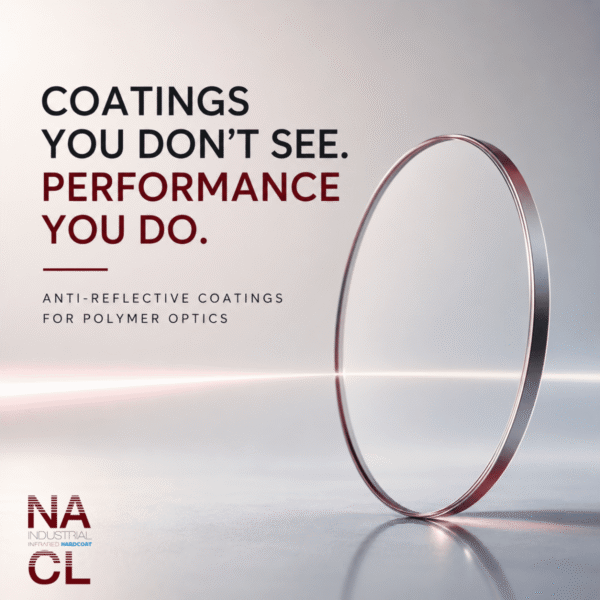
Coatings you don’t see. Performance you do.